
What is a variable cost?
Dec 22, 2014
What is a variable cost? That seems like such a simple question, and I am sure many of you reading this right now are thinking really. Of course a variable cost is simply a cost that increases as production increases and decreases as production decreases. I’m sure many of you are thinking this time of year my patience and available time are pretty variable too! I know I sure wish there were more hours in a day right now with all the holiday preparations yet to be done!
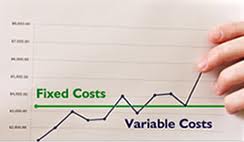 A fixed cost is a cost that does not change regardless as to the level of production. Fixed costs are things like rent and insurance. Even if you only produce one widget you will still have to pay the same amount in rent and insurance, as well as several other items. However; fixed is only within a relevant range. Most likely over a certain period of time the rent you are paying will increase, or the insurance premiums will increase. Notice I did not say decrease-I’m not living in a dream world! If you have a three year lease, then your rent is fixed within those three years. Outside if that time it would not be, as it will most likely change, or vary.
Some people argue that all costs are variable-it just depends on the time-frame, because in the long-run all costs vary. Although that may be true, it is vital to classify costs correctly as fixed or variable. If you classify a variable cost as fixed, depending on your level of production you will have either over or under accounted for that cost, this can be catastrophic. Some costs are more difficult to classify, such as, supervisor costs. You may have to add another shift, which would add another supervisor that you had not expected. If you were just looking at this supervisor cost as fixed you will most certainly under recover this cost.
Direct, or variable costs, are directly related to production. These are things like material and production labor. These costs will in theory, only be incurred if production occurs. The recovery of those costs are directly related to their production. Fixed costs have to be recovered over production regardless as to how much or how little you produce.
There are statistical techniques, like regression, available to determine how dependent a cost is on production to determine if it is variable or not. These techniques can be quite helpful especially if you are unsure as to the classification of a cost. In the end the answer to what is a variable cost is not always black and white, but is very important.
Categories: Cost Accounting
Cost Accounting With A Varying Crew Size
Dec 19, 2014
We recently toured the facilities of a rather small, but technically sound manufacturing firm in Northwest Ohio. This client we have worked with for many years and they have decent costing information given the size of their business. In the past, this manufacturer has benefited significantly from updating and maintaining their costing records. This allows the organization to be current and relevant to what is occurring on the shop floor, as well as with changes in the marketplace. The owner-manager is an experienced businessman who was previously employed at a much larger organization. His experience has helped him recognize the value and importance of investing capital in order to have accurate cost information.
The owner described to us that in the past it was somewhat impossible for one operator to manage two machines due to the layout of the plant and the machinery. The physical location of the machinery and raw materials had been changed to improve operating efficiency. As a result, it is now possible for one operator to run three machines.
 The change in operators required, however, is not a hard and fast rule. The number depends on the types of jobs that are running, the experience of the operator, the availability of other supporting help, and the availability of factory supervision. The standard crew size is not consistent under today’s operations to refine the costing model to reflect one operator observing three machines. This leaves the owner-manager in a quandary regarding proper costs.
As we walked through the shop floor, it was apparent that there were efficiencies being realized by the reduced crew sizes. Nonetheless, as a machine controlled environment, a good part of the cost associated with the operations has less to do with labor and more to do with the cost of capital. The cost of capital includes maintaining and operating the equipment that is necessary to complete the manufacturing process.
The more important question involves the timing of a cost revision. Should a revision be done now with a re-cost all of the products using one operator and three machines? As we initiated this discussion, the owner-manager assumed his machine rates would be cut by a third when he went from one operator, two machines to one operator, three machines. However, as we delved deeper into the conversation, it became apparent that the only real efficiency gained was the spread of the labor cost into three categories, instead of two as done in the past. The other significant portion of the machine rates would not change at all because it was associated with the cost of operating the machines.
Although this is an ongoing discussion, we decided to leave things the same and as consistency increases related to the use of one more machine per operator, we will reconsider. Once this point it reached, we will cost all of the products and reset the quoting rates with the greater division of the direct labor component of these machine rates. To do so now, when many of the jobs are not operated, one man three machines would underestimate the cost of the product and overstate the profitability. Since this is not occurring all of the time, we would risk undercutting ourselves if we changed the rates now.
Categories: Cost Accounting
Driving A Lot? Deduct Your Mileage
Dec 18, 2014
I recently met with a client who is starting a new investment firm. He asked me how to determine if an expense can be classified at a business expense. He told me he drives to meet with potential partners and was wondering if any of that mileage would be considered a business expense. I told him if you are using your vehicle to meet people or to scope out locations, etc. then absolutely, those situations would fall under the business expense category.
The question then came up of how to track these expenses in order to receive the deduction. I explained there are two different methods, the first being the allowance method and the second, tracking the actual expenses. Each of these methods has a sidenote worthy of mentioning. The allowance method must be elected in the first year the vehicle is used for business purposes. If it is not, it cannot be used.

The allowance method replaces taking a deduction for actual operating costs and depreciation. You can, however, deduct parking fees and tolls that are paid for business purposes. If you use the allowance method, you must keep records of your business trips. These records need to be comprised of the date, customer or client visited, the purpose and the number of miles travelled for business. This can be used for leased vehicles as well. However, it must be used for the entire lease period. The log can be kept electronically or on paper, but must be available at the request of the IRS. The total business miles for the year are then multiplied by the IRS standard mileage rate, $.56 in 2014, and deducted on the tax return.
Actual expenses can be deducted in the first year if the allowance method is not elected, or in any future year. This is only true if the vehicle is not leased. However, electing in a future year forfeits any first-year accelerated depreciation that may be available. Actual expenses must be tracked for items like, gasoline, oil, repairs, license tags, insurance, etc. Depreciation or lease payments can also be deducted. If the vehicle is also used personally, then the total expenses are allocated based on the business use percentage. This percentage is determined based on the total miles driven for the year and the business miles driven for the year.
Deducting automobile expenses can surely save you money on your tax return, just make sure you gather the appropriate documentation the select the right method for your deduction.
To receive a free copy of William Vaughan Company’s mileage log, email Jessica Sloan at sloan@wvco.com
By: Tara West, CPA, CMA
Categories: Uncategorized
Can Your Business Save More by Paying More?
Dec 18, 2014
A client recently sent me a notification they received from the Ohio Department of Job and Family Services (ODJFS) informing them that they could reduce their unemployment tax rate by making a voluntary additional payment. Usually, paying more taxes in is something employers try to avoid doing, but for certain employers, making this voluntary payment may save them money.

The unemployment rate that employers pay is largely based on their experience rate – the lower their experience rate, the lower their tax rate. The experience rate is dependent on factors such as how much the employer has paid into its account, how much has been paid out in claims, as well as what the average annual taxable wage amount is. If the employer has paid in enough contributions, their account could reach a certain threshold that could reduce the experience rate. The ODJFS will usually notify the employer whether an additional voluntary contribution would help the employer reach that threshold to reduce its rate.
A basic calculation is included with the ODJFS notification that allows the employer to estimate whether the tax savings is more than what the voluntary payment would be. In the case of my client, it did not benefit them enough to make the voluntary payment, but depending on how many employees your business has, the voluntary payment could end up saving you tax dollars. Please contact your William Vaughan Company representative should you need any further guidance.
Categories: Uncategorized
It’s Beginning To Look A Lot Like . . . Cost Revision Time
Dec 17, 2014
This time of year everywhere you go and practically everything you hear is related to the holiday season. For some, the hustle and bustle of the holidays are filled with excitement and for others, its becomes a nightmare of stress. Whatever it is to you, I do wish you and yours a happy holiday season. Another exciting aspect about this time of year is annual cost revisions.
Doing your cost revisions annually is a necessity. Depending on your industry you may even need to do them more frequently, but typically annually is a good rule of thumb. There may be times during the year that a standard is altered due to a short-term issue. If the time frame is short then this should have been flushed out as a variance. However, if the change in the standard will be for an extended timeframe (meaning the rest of the period) or is substantial, adjustments may need to be made. By substantial I mean anything around a 30% change. Otherwise, standards should be set annually. Consistently altering standards will prevent transparency and create confusion.
 When reviewing your cost revisions, make sure your program is reasonable. Does your cost driver still make sense or did you change your process? Are your standards practical and prove to be accurate? What about your routings? As with any business plan, it is essential take a step back each year and evaluate your direction and growth. A cost revision is no different. Don’t fall into the trap of SALY, doing the same as last year. Taking a step back to review your current costing plan can positively impact the health of your business and get you started on the right track for 2015.
Categories: Cost Accounting